Anti-Cancer Drug R&D Finally Hits the Fast-Forward Button
Humanity has never stopped fighting diseases like cancer, Alzheimer's, and AIDS. But hampered by the slow pace of new drug development, this battle has long awaited a qualitative breakthrough. The emergence of generative AI-powered large models is now fundamentally changing this trajectory.
Produced by | Huxiu Tech
Authors | Chen Yifan, Sun Xiaochen
Editor | Miao Zhengqing
Header image | AI-generated
"AI Native 100" is a column on AI-native innovation launched by Huxiu Tech. This is the 10th article in the series.

Humanity has never stopped fighting diseases like cancer, Alzheimer's, and AIDS. But hampered by the slow pace of new drug development, this battle has long awaited a qualitative breakthrough. The emergence of generative AI-powered large models is now fundamentally changing this trajectory.
The first rays of sunset filtered through the conference room windows as our conversation with Chen Zhigang, founder and CEO of C12, had already been going on for two and a half hours. Shengyuan Bay, where our conversation took place, is a major source of new drug innovation.
What Chen Zhigang is building is a general-purpose robot for laboratory settings — one that will first be deployed in new drug development, and then generalized to new materials, chemical engineering, and other scenarios.
A glint of light reflected off his thick glasses — something sharper than the sunlight outside. At this moment, a wave of innovation is surging across the global pharmaceutical R&D industry, with AI at its core — more powerful and more capable than it was a decade ago.
In 2022, Chen Zhigang's company C12 was founded, aiming to combine domain-specific AI Agents with embodied intelligence to break through the efficiency bottleneck of wet-lab experiments (Editor's note: Wet-lab experiments typically involve the manipulation and processing of biological samples, chemical substances, or other liquid materials. These experiments often require specific laboratory conditions such as sterile environments and temperature control).
Over a year ago, he made a critical decision: to narrow the robot's application scope to the "purification" step, rather than the entire wet-lab workflow — this is the key step where customers feel the most pain and are most willing to pay.
Going back even further, he decided to add hardware to the equation, evolving from an initial AI Agent that designed experiments into a robot capable of executing a complete workflow. The reason? Customers told him that designing experiments only solved 7% of their needs — researchers still spent 70% of their time doing tedious manual labor, and they wanted Agent technology to handle those tasks too.
In short, every decision has been driven by customer needs.
If the previous wave of AI was merely "icing on the cake" for drug development, this generative AI revolution led by large models may be rewriting the rules of humanity's race against disease.
During our conversation, a massive capital flow was underway in the pharmaceutical sector. In the past month alone, nearly $10 billion in capital had poured into the AI pharmaceutical space, with multinational pharma giants like Novo Nordisk, Eli Lilly, and AstraZeneca entering into more than 20 major collaborations with AI companies. This is a clear signal.
According to a report by third-party research firm Evaluate Pharma, the global prescription drug market is projected to reach $1.756 trillion by 2030, with AI-driven pharmaceuticals becoming a core growth engine.
Traditionally, bringing a new drug to market is a long and high-risk process: from early R&D to final market approval takes over 10 years — like building 100 stories, only to see 9 out of 10 buildings collapse, with a success rate of less than 10%. Now, AI technology is injecting new possibilities: by accelerating compound screening, optimizing clinical trial design, and assisting with data analysis, the drug development cycle could be shortened by 30%–50%, with even more significant efficiency gains in certain stages, reducing both the time cost and uncertainty of R&D.
What Chen Zhigang aims to do is push the "starting gun" even further forward. In the traditional landscape of drug development, from target validation to preclinical R&D, 100 researchers in lab coats repeat thousands of pipetting operations in front of fume hoods, accumulating over 1 million hours — equivalent to 114 people working around the clock for 10 years, with $300 million in spending being the norm. This figure has crushed countless small and mid-sized pharmaceutical companies.
The emergence of large models is like a spotlight suddenly illuminating a tunnel. "Large models have laid the foundation," Chen Zhigang says. In some pilot scenarios, preliminary validation has shown that this approach has the potential to multiply production efficiency several times over, with costs dropping significantly, bringing entirely new possibilities to laboratory R&D.
Chen Zhigang's hands once steered the digital transformation at WuXi AppTec, where he served as Senior Vice President and Chief Digital Officer. He also built the foundational architecture for Tencent's Medical Big Data Lab and served as Chief Architect at Alibaba Health. Chen Zhigang says his career trajectory happens to span the entire chain of a drug's journey from R&D to market.
Throughout most of our conversation, Chen Zhigang operated like a precision instrument, with every logical chain fitting together seamlessly. It's hard to read any emotion on his face — even when mentioning the "detours" the company took in its early days, he recounted the startup's early pitfalls in a tone as steady as if he were telling someone else's story. When discussing the identity shift from corporate executive to entrepreneur, he mentioned it only in passing.
Chen Zhigang has mapped out a clear rhythm for each step of the company's future — before the Series A, get the product and operations right, and let customers experience real value.
Targeting the Laboratory Efficiency Bottleneck
Huxiu: Why did you want to start this company in 2022? After all, you had already reached a very good position at WuXi AppTec.
Chen Zhigang: The origin actually comes from two things:
First, when I was at the CRO (Editor's note: Contract Research Organization — a third-party institution providing specialized R&D services to pharmaceutical companies, covering the entire drug development process), I frequently visited the laboratory because our work was closely tied to the business. We used digitalization and intelligent technologies to help business teams improve efficiency and productivity. Scientists actually work incredibly hard — out of an eight-hour day, they spend six or seven hours standing in the lab, either running experiments or moving between different equipment and workstations. When the workload is particularly heavy, they have to work overtime. From a laboratory efficiency perspective, there's enormous room for improvement, and efficiency gains especially need to come from new technologies.
Second, several years ago, I discussed the future direction of the pharmaceutical R&D outsourcing industry with several senior leaders, and they pointed out: the industry's true competitor is a new species that will emerge in the future.
Because of these two things, I started thinking about how laboratories could break through their efficiency bottleneck. First, it's not about pushing human limits further — it's about using new technology to transcend human limitations. Second, I believe we need to use new technology to replace humans in the dirty, tedious work, achieving an organic combination of human and robotic intelligence in both cognitive and physical operations.
This industry has too many challenges. There are many diseases without effective treatments. If we can make people more efficient in laboratory settings, then a single person, within a given amount of time and energy, can explore more unknown territory and find better drugs or materials. That was my motivation for starting this venture.
Huxiu: By 2022, there were already quite a few AI pharmaceutical companies — like XtalPi and Insilico Medicine — already working on AI-driven drug development. Would they be future competitors to C12?
Chen Zhigang: We actually focus on different stages of drug development. Companies like XtalPi and Insilico Medicine primarily use AI technology for drug molecule design — using computational methods to design and screen candidate molecules, which is a very important step. We focus on the wet-lab validation stage. After AI designs potentially promising molecules, they need to be actually synthesized and validated in the laboratory — that's what we use robots to do. So you could say we occupy different positions in the value chain, each leveraging our specialized expertise. In reality, we're complementary.
Huxiu: What problems did the previous wave of AI algorithms fail to solve in drug development? What new possibilities does this generation of large models bring?
Chen Zhigang: The new generative models are critically important for drug molecule design. Large language models enable faster decision-making. With a good foundation model, fine-tuning for different application scenarios requires less data, lower cost, and less time than before. Previously, every vertical track needed its own specialized model. To use an analogy: before, everyone building a house started from sea level — if you wanted to build 100 meters high, you had to build all 100 meters yourself. Now, the foundation already reaches 50 meters, and you only need to build the remaining 50.
Huxiu: After deciding to start a business, what was the first thing you did?
Chen Zhigang: Fundraising and building the team. When we started, it happened to coincide with the pandemic, and at that point, we genuinely experienced a lot of challenges. However, companies in the traditional automation and laboratory automation space were experiencing significant business growth at the time, which gave us good encouragement. If wet-lab experiments could be executed as flexibly as computation, it would be a significant breakthrough for both the supply chain and production efficiency.
Huxiu: In the process of seeking investment, do investors focus more on how the company is defined? For instance, they might define C12 as a robotics company? Or an AI-for-science drug development company? How do you define the company?
Chen Zhigang: Every investor has their own perspective. For a company like ours doing vertical-domain Agent + hardware, it is indeed somewhat challenging for investors overall. Sometimes when we approach investment firms, they start by talking about AI with us, find the domain hard to understand, then bring in the biotech/pharma investment people, who in turn feel it doesn't fit the typical pipeline logic they're used to.
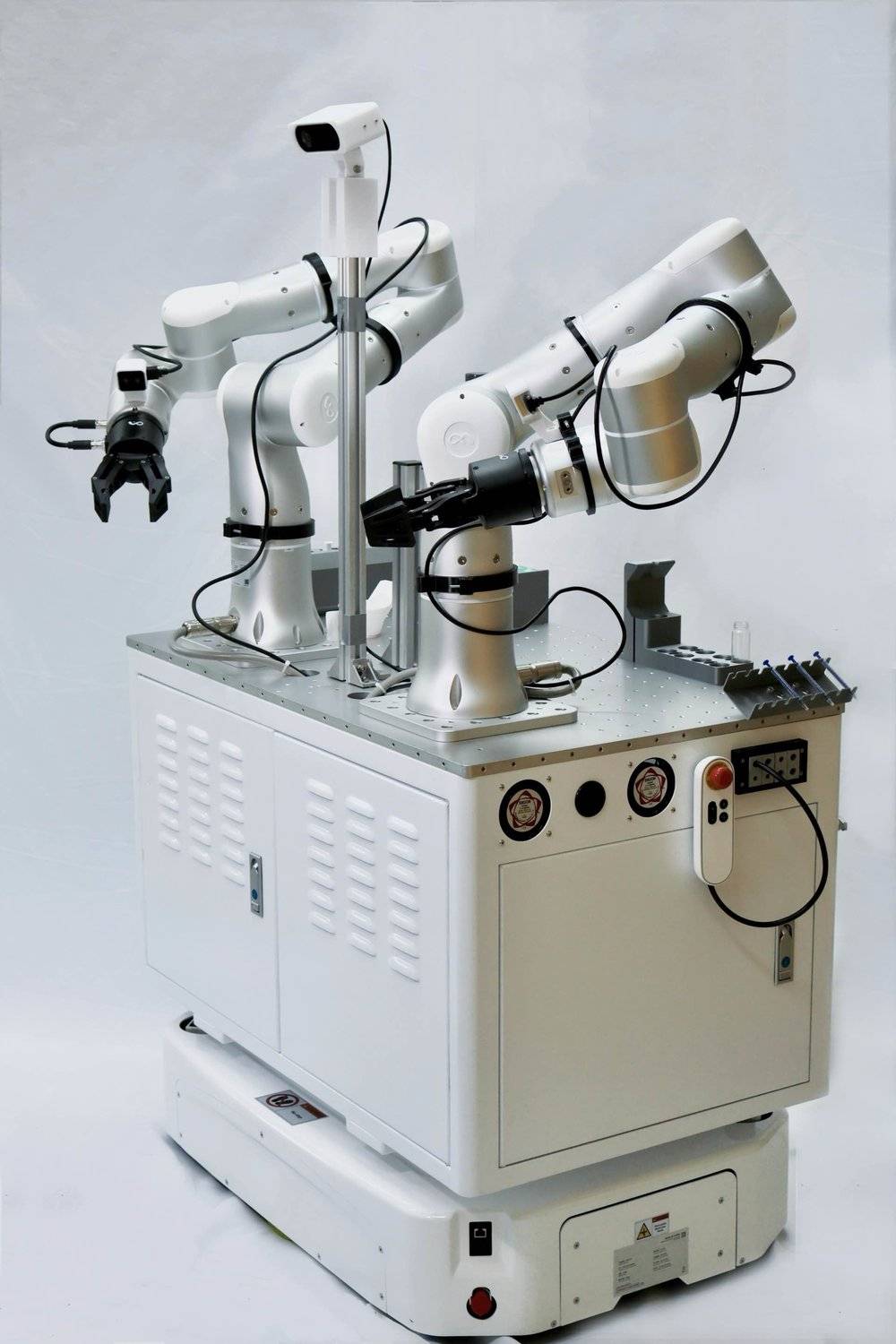
C12's robot product LabBot
I think fundamentally, it's an AI + robotics product. It's perfectly normal that people don't understand it at first. The logic of new AI and robotics applications is evolving, and people will gradually build up their methodologies and frameworks. More investment firms will find it easier to understand over time — it's a process.
The Nails in the Pharma Industry Are Many and Hard — Ultimately, Solving Customer Problems Creates Value
Huxiu: Working at WuXi AppTec, Alibaba Health, Tencent, and other companies on the intersection of healthcare and technology — have these different experiences had different impacts on you? How do these impacts translate into your entrepreneurship?
Chen Zhigang: I think this impact has been continuous and constantly iterating. When I was at Alibaba, on Singles' Day night at headquarters, every business unit would have a large screen displaying two curves — one showing the projected GMV (Gross Merchandise Value) for that business segment, and another showing the actual GMV transactions. Often you'd notice a gap between the two numbers early on, especially when actual GMV fell short of projections. Marketing strategies would be implemented promptly in an attempt to boost GMV. And you'd find that these adjustments were quite effective — the actual curve would gradually approach, and eventually even surpass, the projected curve.
I really did learn something important from that. When a product is applied in real-world scenarios, it needs operations. First, only through operations can you truly help customers use the product well. When a new product reaches customers, they won't necessarily master it immediately, nor will they necessarily fully leverage its value right away. Second, the fit between product and business scenario requires calibration — even if you've analyzed everything thoroughly in advance, there may still be discrepancies in actual application. Third, application scenarios are constantly changing, and the product needs to iterate quickly to meet new demands.
WuXi AppTec had a very important business unit whose core production equipment was pharmaceutical reactors. At the time, orders for that BU were overflowing — despite having many reactors, the matching between enormous demand and supply still posed challenges. We used algorithms to connect the information flow across the entire workflow. Previously, people arranged which project went to which production location, when to start, when to finish, etc. Later, algorithms handled this.
We built an AI product for them that matched supply and demand, and trained the business team to use this product to solve their problems. During use, they had new needs. Because business requirements were changing, their business logic was evolving, and new business strategies were emerging, we iterated these new requirements and changes into the product.
The methodology throughout this process is: solve real problems from application scenarios, form technology and products, go back to validate these products in application scenarios, and continuously refine them to create genuine value. This requires us to be able to both "get in" and "get out." "Getting in" means understanding the problem so that your solution actually addresses it. "Getting out" means having a product mindset — standardizing it and bringing down R&D and operations costs.
Huxiu: How were these methodologies formed? Are they related to your previous career experience?
Chen Zhigang: Years ago, some internet company people would go out to discuss partnerships as if they carried an aura — like everyone was holding a hammer, looking for nails. This may have actually worked in some industries, but in the healthcare industry, the nails are many and hard — you can't just hammer them in easily.
I think the professionalism, complexity, and heavy regulation of this industry require deep understanding. You need to use internet technology, algorithms, and thinking to solve problems — it's not about having internet algorithms like having a hammer and just looking for a nail to hammer. And there are many nails around — hammering just one isn't enough.
I think this is a very important mindset shift. Ultimately, solving customer problems is what creates value. Only by creating value can products be adopted at scale, and only then is the business successful.
Huxiu: Are there any differences between your experience in pharma companies and internet companies?
Chen Zhigang: Previously at Alibaba and Tencent, I was consistently working in the AI plus internet healthcare sector, primarily dealing with downstream healthcare matters. After doing that for a while, I felt I was quite interested in the entire healthcare industry, so I wanted to try working on the upstream side of healthcare.
In reality, many diseases aren't just a matter of efficiency — often the disease itself doesn't have a good solution, meaning unmet patient needs. So I wanted to see what the pain points were on the product R&D side and do something about it. I sometimes joke that my career since returning to China has covered the entire drug R&D and production process — just that I've been moving from downstream to upstream.
Huxiu: Over these three years, were there any particularly difficult times?
Chen Zhigang: Of course. I think I was indeed spending time adapting to a new role, but more importantly, the broader environment was changing, which brought tremendous challenges to most companies. This challenge is a baseline — everyone faces it. During this process, you have to think about how to analyze and understand the challenges brought by new environments more quickly, and whether you can rapidly find ways to adapt and make the product better. As for the difficulties, I mostly view them from a developmental perspective — it's hard, but it's hard for everyone.
Huxiu: What are your considerations for the founding team?
Chen Zhigang: It's all a process. It's hard to say everything is in place from the start. There are resource issues and practical constraints. I often think these things happen naturally. First, you need to identify what kind of person you're looking for. Then comes capability — whether they can actually do the job. Third is adjusting along the way.
Huxiu: How do you think about capability matching and team compatibility? What role does each person play on the core founding team?
Chen Zhigang: Our team is currently small, so we don't actually have that fine a division of labor. When it comes to evaluating people, I think it comes down to two things. First, for people you already know, you have some understanding of them, which reduces some trial and error. Second, even with people you know, as the environment changes, tasks differ, and stress levels vary, reactions and performance will also differ. So I don't think you need to overthink it — hiring itself accounts for 40% of success. The bigger part is calibration, which accounts for 60%.
From Full-Process to Single-Point Breakthrough
Huxiu: When did the first product come out?
Chen Zhigang: We had previously built some things on the AI Agent side, helping customers solve some very complex problems. Our earliest key AI Agent was for drug molecule synthesis route design. In the new drug development space, there are new molecules that no one has ever made before. How should they be synthesized? How do you actually build this molecular structure? This is a critical and difficult problem for the industry.
Huxiu: So the first-generation product didn't include hardware.
Chen Zhigang: No. The first product can be thought of as designing experiments. After that came using robots to execute.
Huxiu: But you already had customers at that point.
Chen Zhigang: Yes.
Huxiu: After the first AI Agent was released, you were already generating revenue since the business model was validated. So why venture into high-cost hardware products?
Chen Zhigang: Customer feedback was that helping design experiments was great, but it only solved 7% of the problem, replacing less than 10% of manual work. Researchers still spent 70% of their time doing tedious labor in the lab, and they wanted us to handle that too.
Huxiu: Can this product be generalized to other scenarios in the future?
Chen Zhigang: We're not only looking at pharmaceutical R&D. We're also looking at new materials and chemical engineering.
Huxiu: Was this planned from the beginning, or did it come through iteration?
Chen Zhigang: Actually, customers came to us. We had posted a few videos without any commercial promotion. Early videos on WeChat Channels reached 700,000 views. This really reflects the industry's demand for this kind of solution. Many customers reached out to us, feeling this was very valuable and had great potential, wanting to work together on things — and it wasn't just pharmaceutical R&D.
Huxiu: Between model training and hardware, do you control how you allocate your efforts? Both are tough nuts to crack. How far should hardware go? How do you judge the priorities?
Chen Zhigang: We've actually given significant thought to the boundaries of this. If a particular demand is very clear and the market is large enough, equipment manufacturers will typically pay attention to it. If there's no mature solution yet, there may be factors like technical barriers, cost considerations, or market timing. If the hardware demand is too complex, we usually revisit the solution design approach to see if there's a simpler and more efficient implementation path.
Huxiu: You never planned to go in the humanoid direction from the start?
Chen Zhigang: Whether it's humanoid or not isn't that important to us. What we care most about is dual-arm coordination.
Huxiu: During the R&D process, how did you abstract these workflows and create a closed loop with the AI system?
Chen Zhigang: This was all done together with our customers — just like when we were at WuXi AppTec, we'd dive deep into understanding the workflow and do extensive analysis. We look at the workflow from a project execution perspective, breaking it into stages, considering what the machine needs to do at each step, what humans need to do, and what the ROI of each step is.
Huxiu: Large models today still have hallucinations, and general-purpose robots lack sufficient real-world interaction data, preventing large-scale commercialization. These factors can affect decision accuracy. In a scenario like pharmaceutical R&D where precision, accuracy, and stability requirements are even more demanding, how do you solve this problem?
Chen Zhigang: To address hallucinations, you first need to break complex problems into simple ones — this reduces the space for hallucinations. Second, you need grounding — the ability to ground outputs to a foundation that can be validated against reality.
Our current approach is a general-purpose robot that serves as the core hub, connecting many different specialized instruments. We add customized fingers to the general-purpose robot because operating different equipment requires different robot fingers — in these areas, we create some adaptations. This way, we can overcome the limitations of the old All-in-One systems that required heavy customization, achieving a more flexible and cost-effective laboratory automation solution.
When we started, we were thinking about being universal within pharmaceutical R&D laboratories — we hadn't considered other industries. But there's an underlying logic here: emergent opportunities. Because we're essentially using a general-purpose robot to interface with different equipment, other industries face the same problem. The model we use in pharmaceutical R&D is actually applicable to other industries as well.
Second, people have realized that developing customized hardware products takes extremely long and costs significantly more — 4 to 5 times more than software products. Everyone has been considering whether a universal solution exists — one that doesn't need such high throughput but needs to be versatile and flexible.
Third, thanks to the rapid development of the robotics ecosystem, the benefits are that it has broadly entered the public consciousness, making it easier for people to understand and accept. Costs are continuously decreasing, and robot capabilities are constantly improving. In a closed, customized system, cost and iteration cycles aren't advantages — they become burdens. But in an open ecosystem, these things become future advantages. For startups, the question is whether you can establish your competitive moat.
Huxiu: How do you quantify ROI?
Chen Zhigang: From this perspective, we are a robotics company — and this is a key distinction from traditional All-in-One automation systems. First, we charge by workflow. Workflows are essentially the robot's skill packages — if the robot can do more tasks, the rental fee is higher; if fewer, the fee is lower. Our future business model for robots is lease-to-own.
Many customers have told us that robots iterate too quickly and they want to always use the latest ones. Other customers don't know if the robot can actually solve their problems. From the customer's perspective, these are legitimate needs. From our perspective, first, the trend is really pay-for-results. Second, because hardware is involved, customer acquisition costs and timelines are significantly reduced.
Huxiu: Can you explain that further?
Chen Zhigang: Traditional All-in-One automation systems typically require an initial investment of millions or even tens of millions of yuan, classified as capital expenditure (Capex), with high decision-making costs and long cycles. In large enterprises, these decisions often involve multiple departments and more than a dozen stakeholders. In contrast, the lease model is classified as operating expenditure (Opex), with an approval process typically taking half the time of Capex. Equipment rental prices are generally one-fifteenth to one-twentieth of the purchase cost, significantly reducing the cost of trial and error and facilitating quick validation of new technology effectiveness.
Huxiu: For the current business model, will there be a particular focus going forward? Is any segment performing better in terms of revenue?
Chen Zhigang: We're currently selling, experimenting with leasing, and offering software subscriptions. All have market demand, and we're pushing all of them, but our focus will be on lease-to-own. We've talked to many different customers and found this is what the market wants. As part of the procurement process, customers can try it out first, get preliminary data, and then proceed more smoothly with procurement.
Huxiu: There's no unified pricing yet?
Chen Zhigang: The pricing naturally aligns with what customers are willing to pay — that's the market price. From a pay-for-results perspective, what constitutes "results" has different definitions in different scenarios. We have some algorithms for this, but we refine them through customer discussions and iterate continuously throughout the commercial partnership process.
Huxiu: Looking back from today to when you started in 2022, what are three decisions you feel you shouldn't have made or should have changed?
Chen Zhigang: We took some detours in our early days. Initially, we were trying to solve it as an industry-wide problem. The industry has many problems spanning all aspects, so we were looking very far ahead and very broadly. For example, in chemical experiments, from weighing and feeding reactants, to monitoring the reaction process, to post-reaction processing — there could be ten to twenty different tasks to solve. Each task has variations — weighing alone involves liquids, solids, and solids further break down into viscous, chunky, powdery forms, plus many other details. We wanted to use AI to automate the entire process, but ultimately found we couldn't solve any single step thoroughly enough.
Huxiu: How long did this detour last?
Chen Zhigang: About six months to a year. I realized we couldn't look so broadly — we needed to grab one problem and solve it. We shouldn't look at a whole surface; we should start with a single point. What we're doing now is purification. This was a decision we made through continuous communication with customers — many customers didn't spend much time on feeding and weighing, but they spent enormous amounts of time and manpower on the purification step.
We ultimately focused on solving this key step that causes the most pain and where customers are most willing to pay. Throughout this process, I'm deeply grateful to our partners and pilot customers for the trust and feedback they gave us during the exploration phase. Their real needs drove us to focus our product and refine our solution, helping us get on the right track faster.
As for robots, when we first started using general-purpose machines, we tried different robot hardware and did some preliminary integration ourselves. But now we use supplier integrations. Throughout the entrepreneurial process, our understanding of this has been continuously deepening.
Huxiu: Beyond the purification workflow, will you enter other steps?
Chen Zhigang: Yes, including the entire reaction process R&D, as well as biological assay experiments. Many customers have approached us. We don't have enough people to handle all the demand — the R&D team is urgently expanding to keep up.
Huxiu: In the process of co-creating with customers, does customer data become part of your vertical model?
Chen Zhigang: No. If a customer wants to incorporate their data into the model, there are really only two approaches: one is using customer data to strengthen or improve the model, but that model is exclusively for that customer — I can't take it and sell it to others. This is often the more common approach. The second is forming a strategic partnership with certain customers — they might even take some equity and become shareholders, contributing some of their data. In that case, the company's development becomes closely tied to that customer's interests.
Huxiu: How do you determine whether a customer's need is genuine?
Chen Zhigang: You have to talk to the customer and see how much they're willing to invest in it.
Huxiu: For a startup, is there any advantage in sales and partnership discussions? Does this industry tend to trust big brands more?
Chen Zhigang: Traditional All-in-One systems do tend to favor big brands. But now, customers ultimately want to see whether the problem is being solved well. As long as the customer's core problem hasn't been well addressed, there will usually be new opportunities in the market.
"I Don't Start with Assumptions — I Follow the Problems"
Huxiu: In the entrepreneurial journey, have you discovered anything counterintuitive?
Chen Zhigang: In this field, most things fall within the expected range of understanding. But I'm definitely paying attention to new possibilities that could become opportunities for us going forward. For instance, traditional startups basically need five people, but now in Silicon Valley, there are one- or two-person startups that build the product and iterate rapidly. I myself use a lot of AI tools for many different things — right now, my primary use is AI tools as thinking assistants.
I think these new developments really do bring some counterintuitive approaches. I pay close attention to these new methods and hope to apply them to our company's operations and R&D.
Huxiu: Where will the next challenges be?
Chen Zhigang: I think the next step is to fully penetrate key customer scenarios and form a sustainable development model. We're actually on this path right now. Before the Series A, to be accepted by the market, we need product, operations, and the ability to deliver real value to customers. After customers adopt it at scale, we can expand to other laboratories and achieve scalability. We're currently building up capabilities — once we've fully penetrated these scenarios, when we move to other application areas, we'll at least know how to proceed.
Huxiu: What are the current difficulties with scaling?
Chen Zhigang: It's more about being a new thing. When there are actually many robots working in the lab, what new problems will customers face, and how do we help customers deal with them? Because this kind of thing has never happened before.
Huxiu: This is also one of the interesting aspects of this wave of entrepreneurship — everyone is trying new things, and everyone is on the same starting line. The future is unknown.
Chen Zhigang: Yes. Throughout this process, I don't start with assumptions. I follow the customers, follow the problems — when problems arise, I solve them. In terms of the initial underlying logic design, this has actually given us excellent tooling support and helped us build up strong capabilities. For example, when I encounter a problem at a customer site, can I reproduce it in our simulation environment? If I can reproduce it, then through that process, I've accumulated a lot of experience. This experience isn't just accumulated in people's heads — it's accumulated on the product's R&D platform.
Huxiu: What's your timeline for the company's development?
Chen Zhigang: I think by the end of this year, we'll have fully penetrated one or two major customers in the industry. By next year, we'll start scaling. Looking further ahead, I'd prioritize expansion within the pharmaceutical industry first, then look at other industries. In other industries, we'd concentrate resources on one or two points, iterate quickly, and then potentially bring in new resources to collaborate.